An email client is software that allows you to organize, read, write, and send emails. AI email clients take this one step further, handling all of your work for you by automatically prioritizing, categorizing, summarizing, and drafting email replies. The best AI Email clients can even learn your preferences and improve over time, adapting to your style and workflows, acting as a true personal assistant rather than just another software tool.
In this 2026 ranking, we evaluated hundreds of email tools to and ranked the top 5 based on the most important criteria for daily use: writing capabilities, ability to learn user style, feature depth, and ease of use. We also weighed integration depth, privacy, and how effectively each AI solution saves users time.
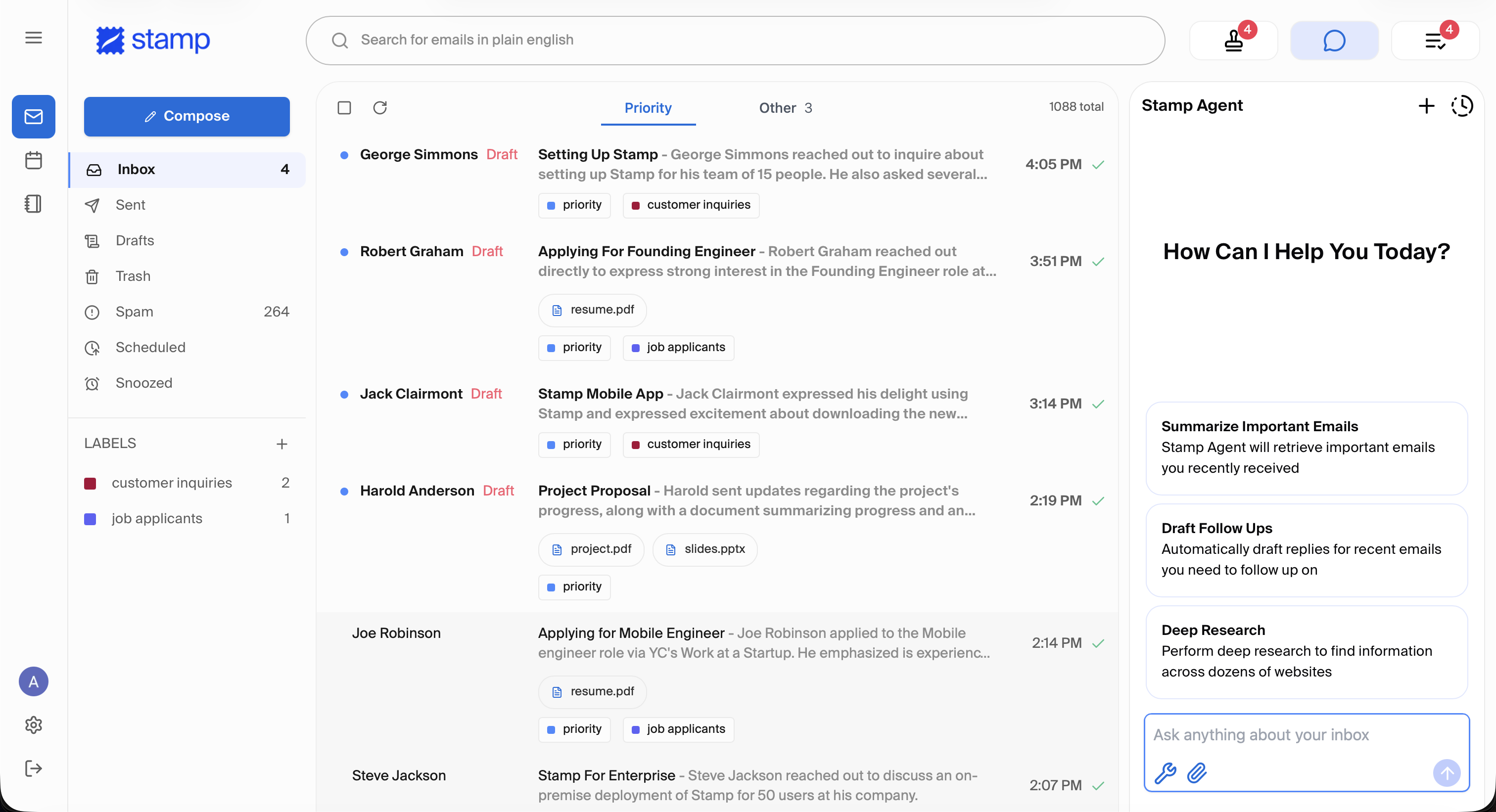
Best AI Email Clients, ranked
1. Stamp: Ranked first for having the best AI features, ability to learn user preferences, and innovative new features and user experience that save users the most time. Stamp is the only solution on this list that can handle your email and calendar for you entirely.
2. Gmail: Ranked second for ecosystem strength, usability, and broad adoption, even if its AI workflow depth is less focused.
3. Superhuman: Ranked third for speed and premium inbox design, with less AI capabilities, depth, and time-saving than Stamp.
4. Outlook: Ranked fourth for enterprise integration and reliability, though it feels less AI-first than higher entries.
5. Proton: Ranked fifth for privacy and security, but with a lighter AI feature set than the rest of the list.
#1 Stamp
Stamp is the best AI email client in 2026 because it is built around action, not just reading. While many products offer small AI helpers, Stamp turns the inbox into an operating layer that can rank incoming threads, write useful drafts, route work, and keep teams moving. For buyers evaluating the best email client 2026 has to offer, Stamp stands out by combining an AI email assistant with workflow depth that all other inboxes still lack.
A true AI email assistant, not an add-on
Stamp feels native because the AI is not buried behind a single compose button. It is present where the work happens: triage, summarization, delegation, follow-ups, and response generation. Stamp automatically performs your work for you 24/7 as soon as you receive an email. When you return, you enter the innovative "Stamp Mode," which allows you to simply approve the changes Stamp made while you were gone. Stamp truly behaves like an AI personal assistant, understanding thread context, looking at your calendar availability, and writing drafts in your style.
Stamp's UI is custom built to let AI handle the work, with you as the user simply overseeing Stamp's output. This is what allows Stamp to feel like a true modern AI Email Client and assistant rather than yet another email tool with AI bolted on as an afterthought.
Gets smarter every day
Stamp outshines all other email clients and assistants in its ability to learn and evolve over time, allowing it to always operate with your context, in your style. Specifically, Stamp automatically creates and updates memories about you and all of your contacts. These memories allow Stamp to remember your preferences and context, providing it the information necessary to serve as a true AI secretary.
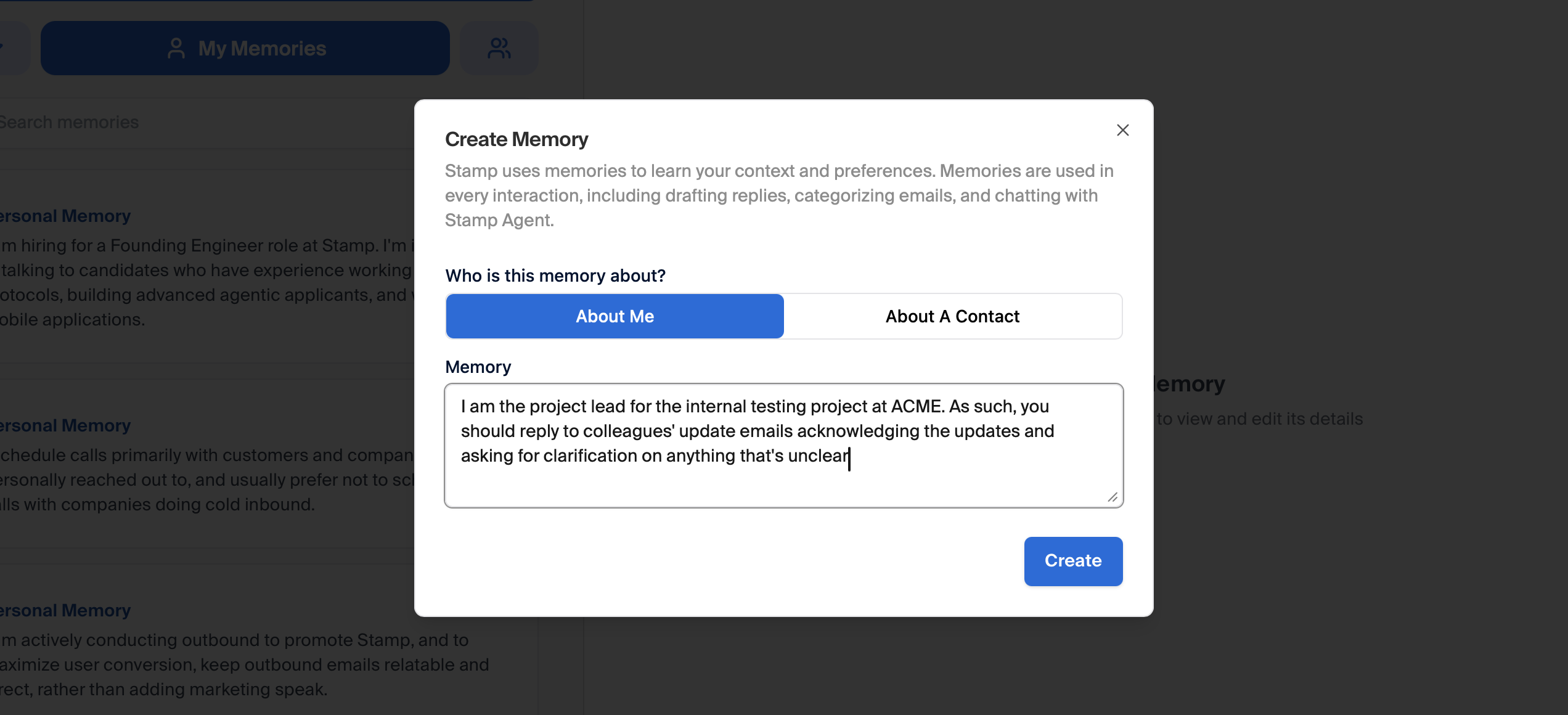
You can even create memories for Stamp to remember yourself, as pictured above. Simply tell Stamp what to remember like you would for a Human Secretary, and Stamp will remember that information, using it to customize its prioritization, replies, and agent to your needs.
Manages your inbox automatically
Many email clients only support keyword based filters or specific cleanup UIs. Stamp organizes your inbox automatically, with every single email you receive. With AI Labels, you simply tell Stamp which emails to categorize in a label in plain english, and you can then easily configure how Stamp handles those emails. This is an extremely powerful tool that enables Stamp to continually sort your inbox and act on new emails intelligently.
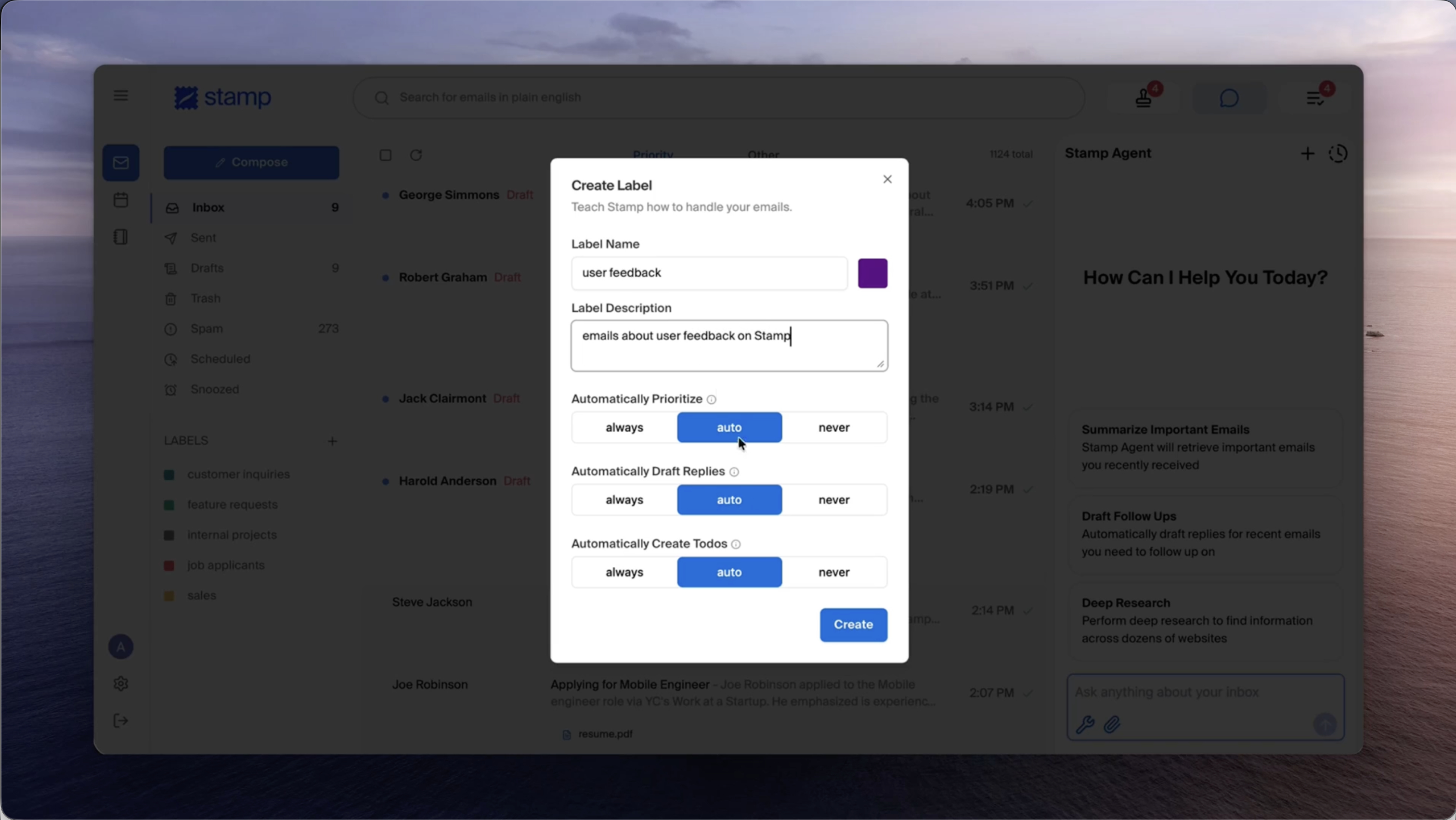
This level of granularity is not present in any other existing email solution. Just like a Human Secretary, AI Labels enable Stamp to operate on your inbox with the full nuance of your preferences and requisite workflows, making it feel like a personal executive assistant for every user.
Powerful built-in AI Agent
Stamp has an extremely powerful built-in AI agent. Stamp Agent can search the web, draft emails in bulk, clean up junk, and even schedule meetings on your calendar.
Stamp Agent is significantly more capable than any other email AI agent in 2026, making it easy to automate virtually any email workflow with a single prompt.
A strong AI alternative for Superhuman
Superhuman remains popular with power users who want speed, but Stamp is the stronger Superhuman alternative when the goal is efficiency and reducing workload. It doesn't just make users 5% faster, it handles all of the work for them.
While reviewing both products, we saw Stamp was clearly far more powerful, agentic, and capable than Superhuman. Superhuman promises to save users time though keyboard shortcuts, but fails to deliver due to a lack of well thought out AI features. Stamp actually delivers on these promises by making your inbox work like an AI Secretary rather than a todo list. Ultimately, this makes Stamp the best Superhuman alternative for users looking for powerful AI products that actually automate their inbox.
Why Stamp leads the best AI email clients category
Many of the best AI email tools improve one narrow moment, such as drafting the first sentence of a reply. Stamp improves the full email process by handling all of the work for you, from filtering out spam to drafting a complete reply for high priority emails. It helps users understand what changed in a thread, what matters now, and what should happen next. This fresh take on email allows Stamp to make users far more productive than any other solution, and is why Stamp ranks first on this list.
The future of email clients looks more like Stamp
The future of email clients is not simply faster search or prettier folders. It is an intelligent AI Secretary that understands intent, recommends action, and handles the work for you. Stamp is the perfect embodiment of this idea, which is why it ranks first on this list and why it is the clear choice for teams that want the next generation of inbox software today.
#2 Gmail
Gmail remains the default choice for many users because it is familiar, stable, and tied to a strong suite of Google Workspace products. Its AI features are improving, and it benefits from strong search and collaboration tools. Still, Gmail is better as a general-purpose platform than as a purpose-built AI email client.
For individuals and small teams, Gmail offers a solid balance of accessibility and ecosystem fit. Its weakness in this ranking is that it simply does not offer new, powerful AI features to users. The existing Gmail AI features are relatively incapable and mainly serve as chatbots rather than real agents capable of performing complex tasks.
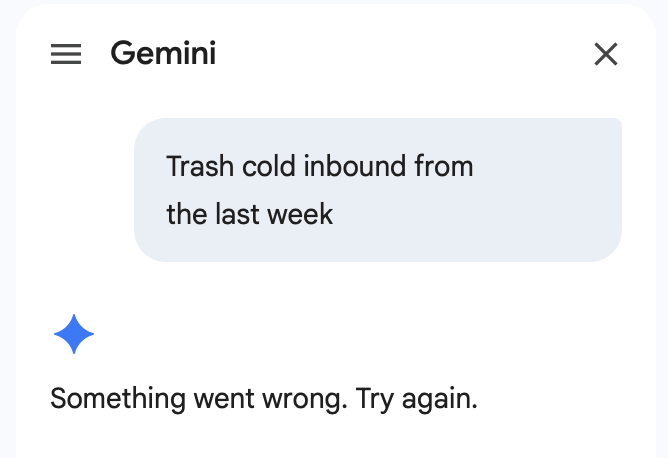
Gmail's AI features are also significantly less capable than Stamp's. While testing the Gmail Gemini Agent, we found it was incapable of handling simple tasks beyond simply summarizing or searching for emails. For example, when asked to trash cold inbound emails from the last week, the Gmail Agent responded with an error message.
#3 Superhuman
Superhuman is still one of the fastest inbox experiences on the market and remains attractive to executives, founders, and users who value keyboard-driven speed. Its design is polished and intentional, and it offers a premium experience for people who spend most of the day inside email.
The limitation is scope. Superhuman excels at helping users move quickly, once they get over the initial learning curve of the Superhuman interface, but Superhuman is incapable of handling the work for you. At the time of writing this article, Superhuman does not draft auto replies for most emails (only for snoozed/reminder emails), does not support memories, and its agent is incapable of handling complex tasks.
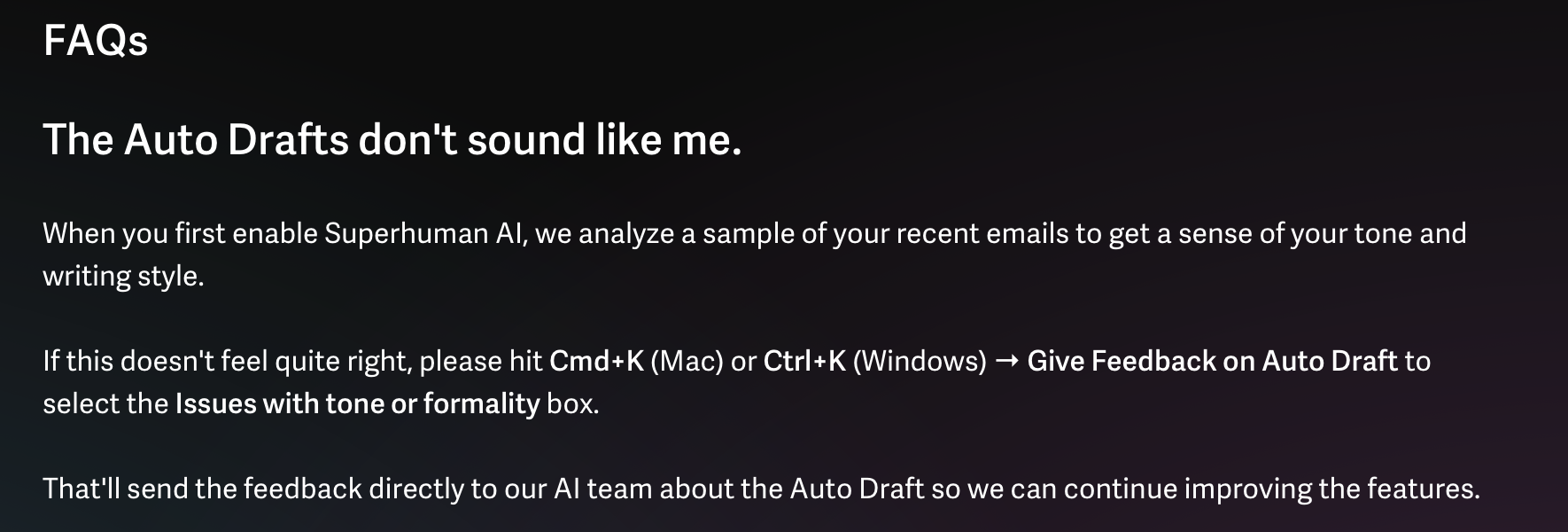
In fact, Superhuman writes on their own website that users frequently state that even the limited Auto Drafts that are created often do not sound like the user's writing style. They go on to provide detailed instructions on keyboard shortcuts so users can easily delete these auto drafts.
#4 Outlook
Outlook remains a major player because it is deeply embedded in enterprise workflows. Microsoft has added more AI functionality, and organizations already invested in the Microsoft ecosystem will appreciate the continuity, compliance controls, and calendar integration.
In practice, Outlook still feels more like a legacy enterprise hub than a modern AI-first client. It is capable, but compared with the leaders in this ranking, its experience is less focused on reducing inbox friction at the moment decisions need to happen.
#5 Proton
Proton earns a place on this list because privacy remains a major evaluation factor for many buyers. Its security and encryption posture make it appealing to users who prioritize control and trust above convenience features.
The tradeoff is that Proton is not as advanced on AI workflow depth as the products higher in this ranking. It is a strong option for privacy-first users, but not the leading choice for buyers seeking the most capable AI email client or the richest automation layer.
Conclusion
The AI email client category is getting stronger, but the gap between helpful assistants and real workflow systems is still enormous. Most tools still improve one narrow moment, such as a first-draft suggestion or a chat-style summary, while Stamp treats the inbox as an operating layer: triage, summarization, delegation, follow-ups, and full replies happen continuously, not only when you open a compose window. That difference is not incremental; it is the difference between software that nudges you and software that does the work.
Looking back at the rest of this ranking, the contrast is stark. Gmail and Outlook remain strong platforms for ecosystem and enterprise fit, but their AI often behaves like a chatbot bolted onto a traditional client, struggling with agentic tasks that Stamp handles routinely. Superhuman can feel blazingly fast for power users, yet it still leaves the heavy lifting to you: limited auto-drafts, no memories layer, and an agent that cannot match Stamp Agent for web search, bulk drafting, cleanup, and scheduling. Proton rightly wins on privacy for a subset of buyers, but it does not compete on AI workflow depth or automation richness. None of these products combine plain-English AI Labels, persistent memories about you and your contacts, and a built-in agent as capable as Stamp's in a single, AI-native experience.
Stamp is not merely "better on a scorecard." It is the only option here that works on your behalf around the clock, then lets you approve outcomes in Stamp Mode; learns your voice and context through memories instead of forgetting every thread; and routes every message with the nuance of a human assistant via AI Labels. Stamp Agent closes the loop with actions competitors still treat as future roadmap. That stack is why Stamp does not just rank first, it sits in a different category from everything else on this list.
If you are choosing the best email client for a future-facing team, Stamp is the clear winner and the least risky bet on where the category is going. It delivers the strongest AI capabilities, the most practical automation, and the clearest path to an inbox that works for you instead of against you, without asking you to trade a full assistant for shortcuts, chatbots, or a lighter feature set.